Pearson Edexcel · GCSE · English Literature
Critical Reading
Mastering Critical Reading is the key to unlocking top grades in GCSE English Literature. This guide will transform how you analyse texts, moving you from simply retelling the plot to developing perceptive, evidence-based interpretations that examiners reward.
- 5 min read
- 2 worked examples
- 4 practice questions
- 8 key terms
Study Notes
Overview
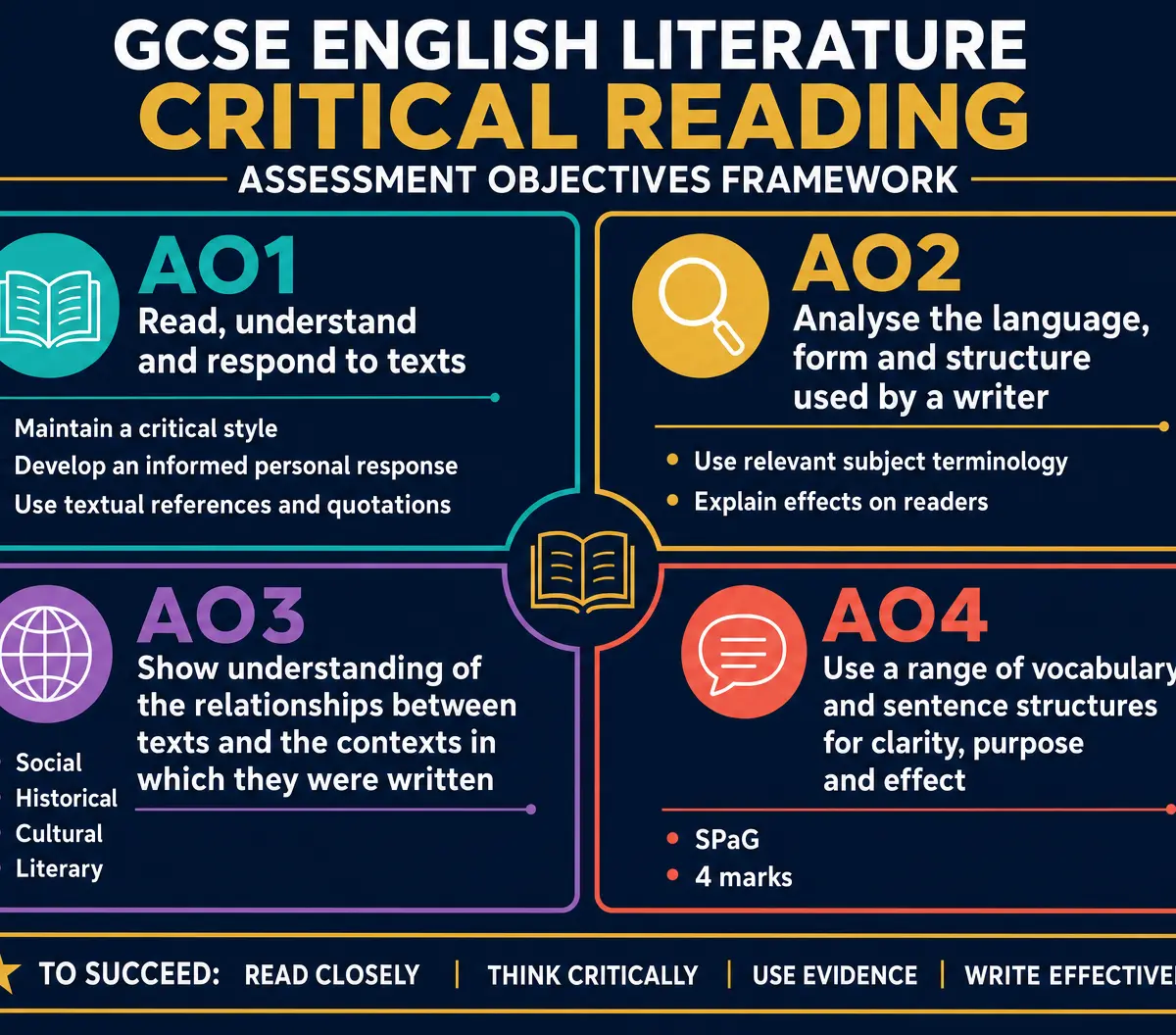
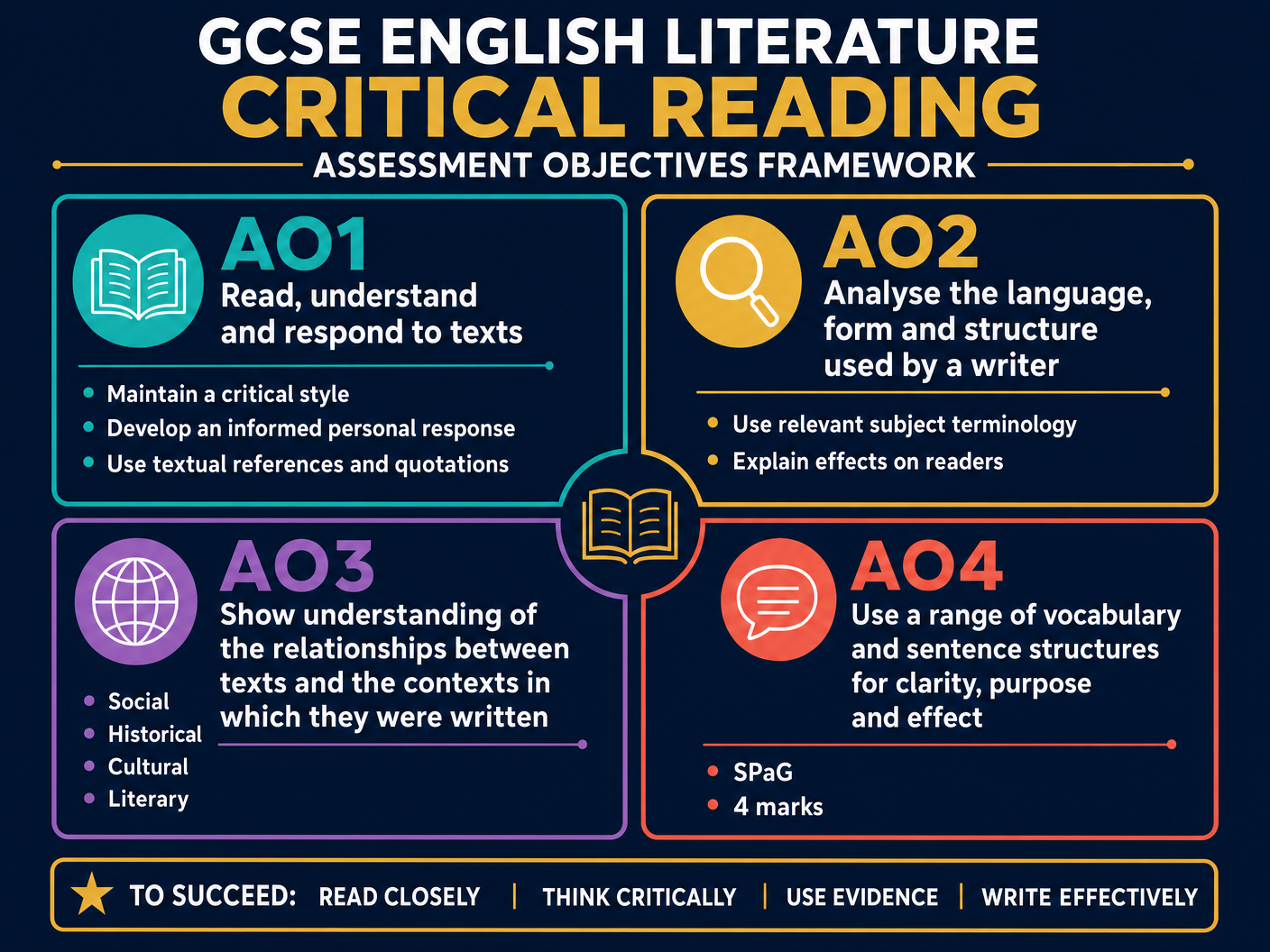
Critical reading is the fundamental skill assessed across all your GCSE English Literature papers. It is not a single topic or a specific text, but the analytical lens through which you must examine every play, novel, and poem you study. Examiners are not looking for you to simply demonstrate that you have read the text; they want to see how you read it. They reward candidates who can identify themes, analyse the writer's methods (language, form, and structure), integrate relevant contextual knowledge, and construct an informed, personal response supported by precise textual evidence. This guide breaks down the mechanics of critical reading, showing you exactly how to approach texts to secure marks across all Assessment Objectives (AOs).
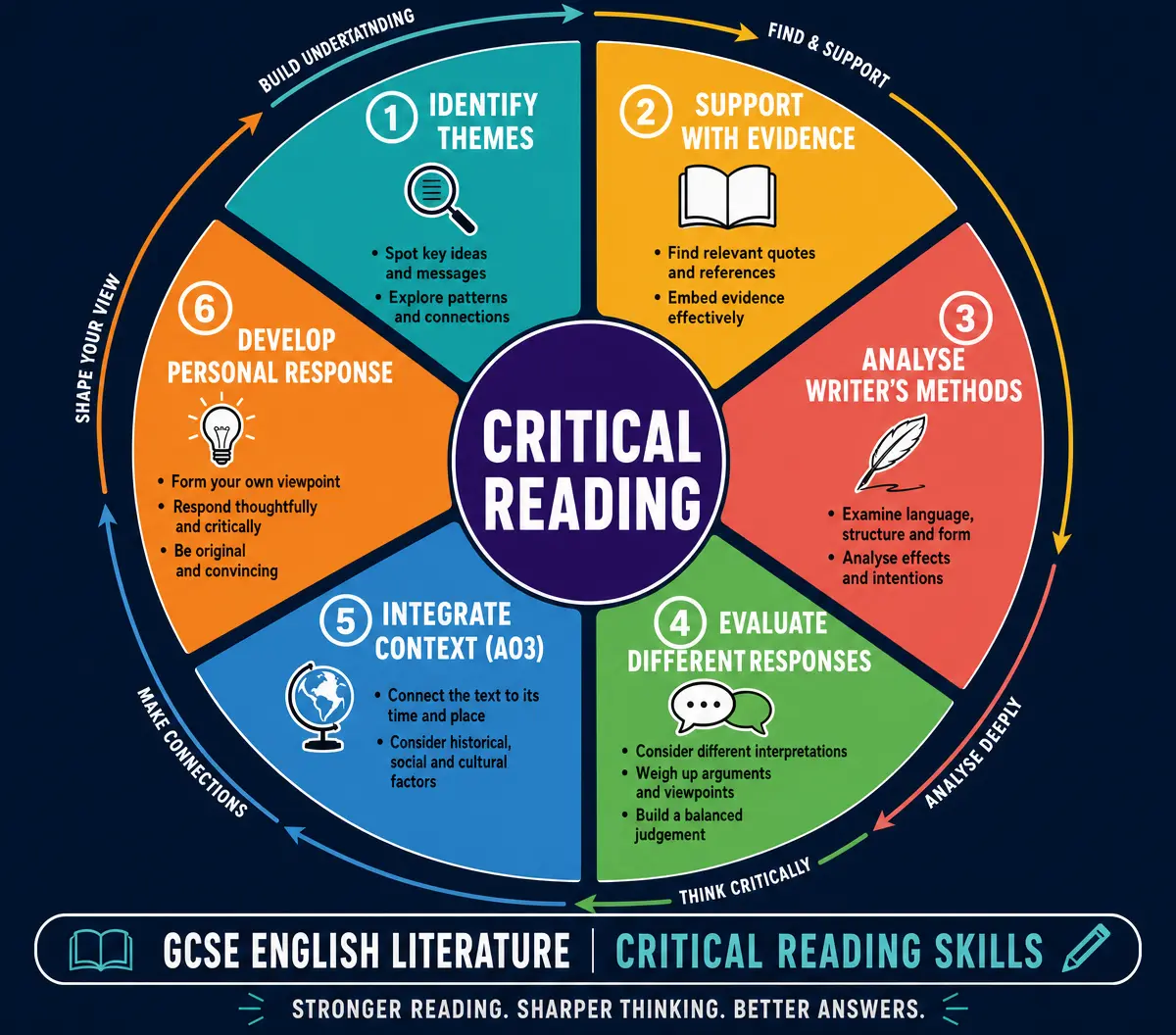
Core Critical Reading Skills
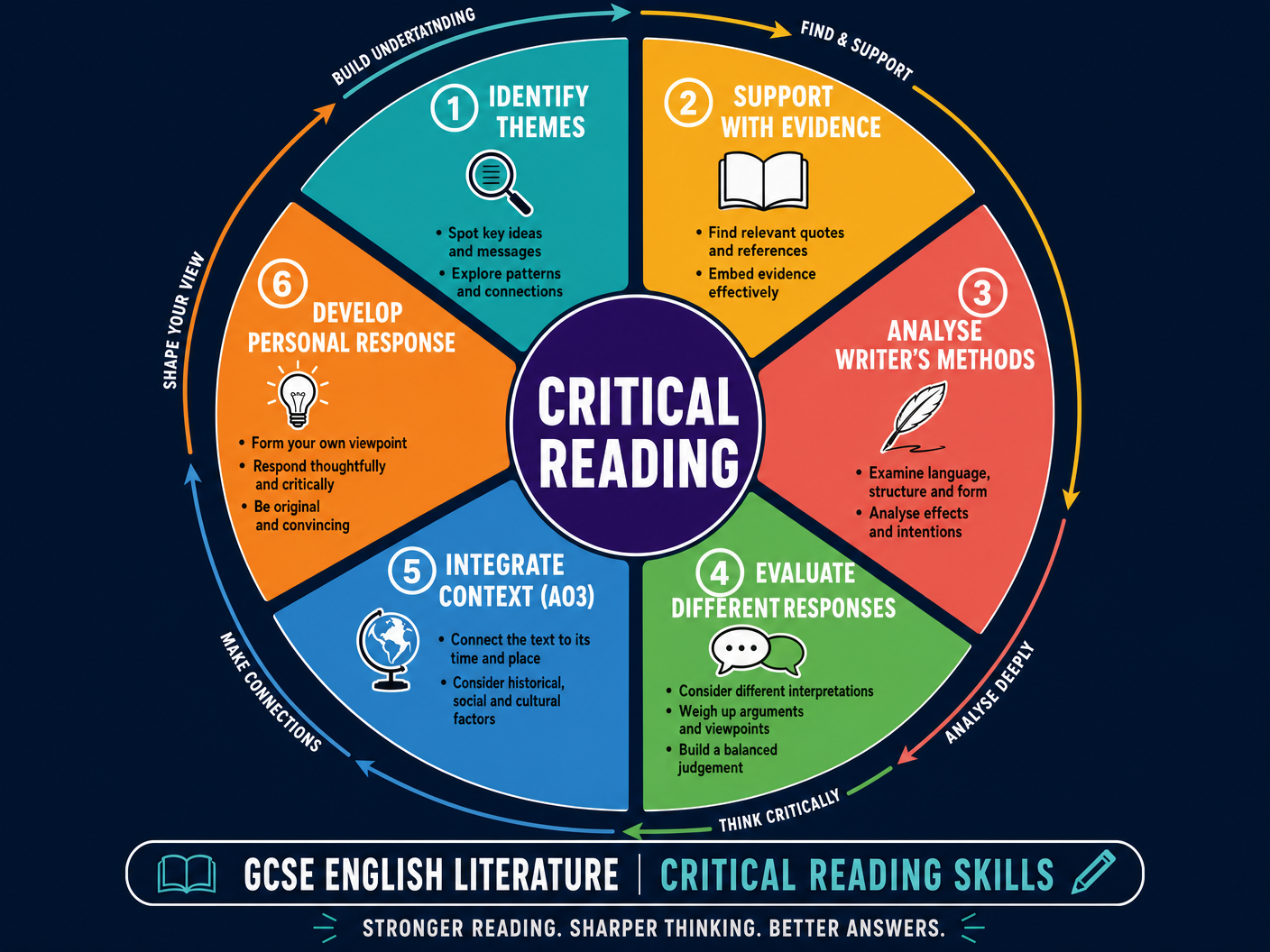
1. Identifying and Distinguishing Themes
What it is: Recognising the central ideas, messages, or arguments the writer is exploring (e.g., ambition, social inequality, the corrupting nature of power).
How to do it: Don't just spot a topic; formulate a critical statement about it.
- Weak: "The theme of power is in the text."
- Strong: "The writer presents unchecked power as a corrupting force that ultimately isolates the individual."
Key Examiner Advice: Trace how a theme develops. Where is it introduced? How does it climax? How is it resolved? This shows an understanding of the whole text.
2. Supporting Interpretations with Evidence (AO1)
What it is: Using precise textual references, including quotations, to back up every claim you make.
How to do it: Never leave a quotation "floating" or isolated. Embed it fluently into your own sentences.
- Weak: "The character is angry. 'He roared with fury'."
- Strong: "The character's intense anger is evident when he 'roared with fury', suggesting a loss of rational control."
Key Examiner Advice: Shorter, embedded quotations (1-4 words) are often more effective than long, copied-out sentences. They show you have selected precisely the right evidence.
3. Analysing Writer's Methods (AO2)
What it is: Examining the language, form, and structure the writer has chosen, and explaining the effect of those choices on the reader.
How to do it: Move beyond "feature-spotting". Naming a technique (e.g., metaphor, juxtaposition) earns no marks on its own; the marks are in the analysis of its effect.
- Weak: "The writer uses a simile when they say 'heart of stone'."
- Strong: "The writer's use of the simile 'heart of stone' suggests an impenetrable, cold nature, implying the character is entirely devoid of human empathy."
4. Evaluating Different Responses
What it is: Acknowledging that texts are ambiguous and can be interpreted in multiple ways (e.g., a feminist reading vs. a Marxist reading).
How to do it: Use tentative language ("This could suggest...", "Alternatively, it might be interpreted as..."). Weigh up which interpretation is most convincing based on the evidence.
Key Examiner Advice: This is a hallmark of a perceptive, Level 5/6 response. It shows you understand that literature is not a puzzle with a single "correct" answer.
5. Integrating Context (AO3)
What it is: Using your understanding of the social, historical, cultural, and literary context to inform your evaluation of the text.
How to do it: Never "bolt on" a paragraph of history. Context must illuminate the text.
- Weak: "The author lived in the Victorian era, which was very strict."
- Strong: "The rigid social expectations of the Victorian era are reflected in the protagonist's suppressed desires, highlighting the conflict between individual freedom and societal conformity."
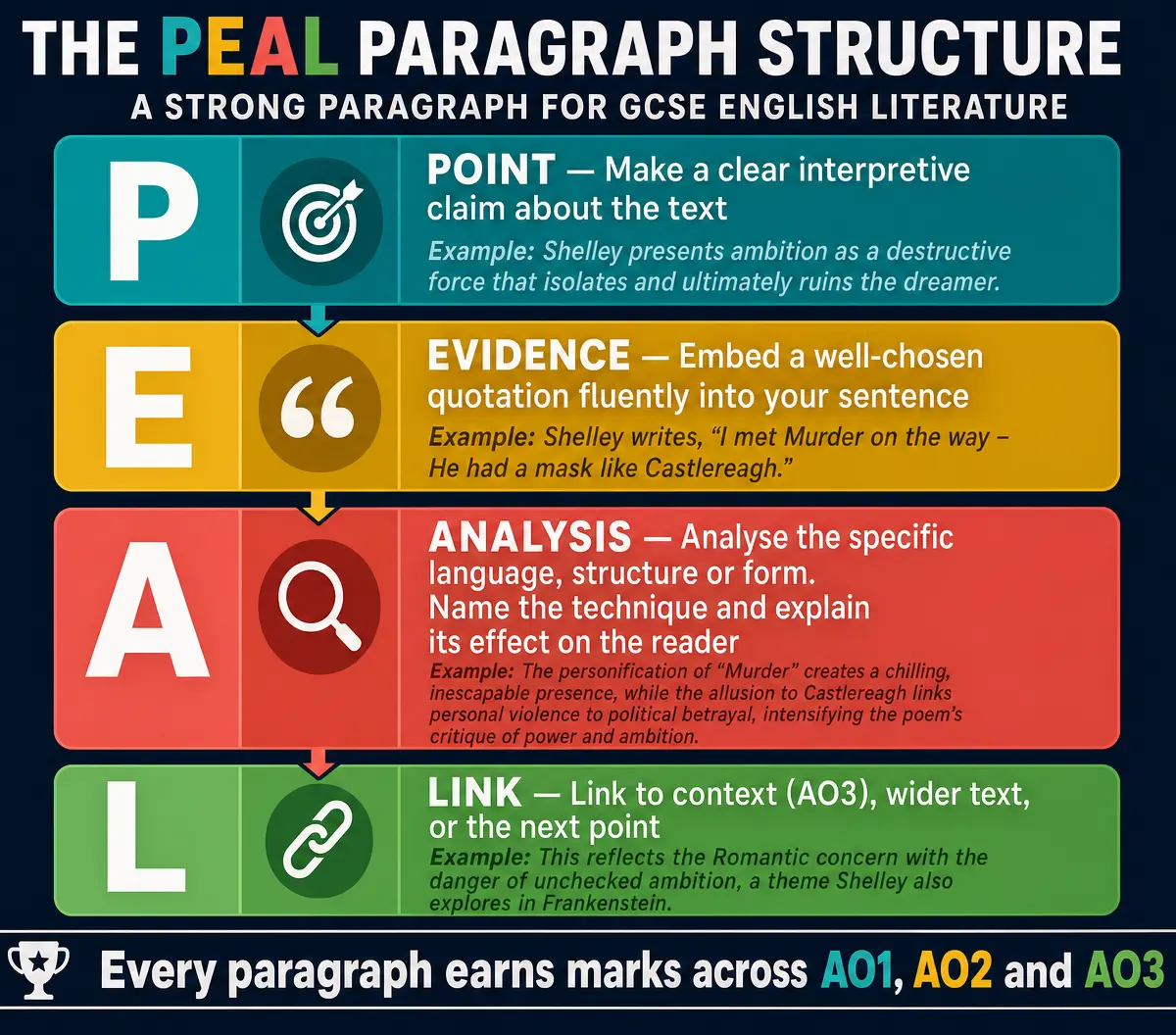
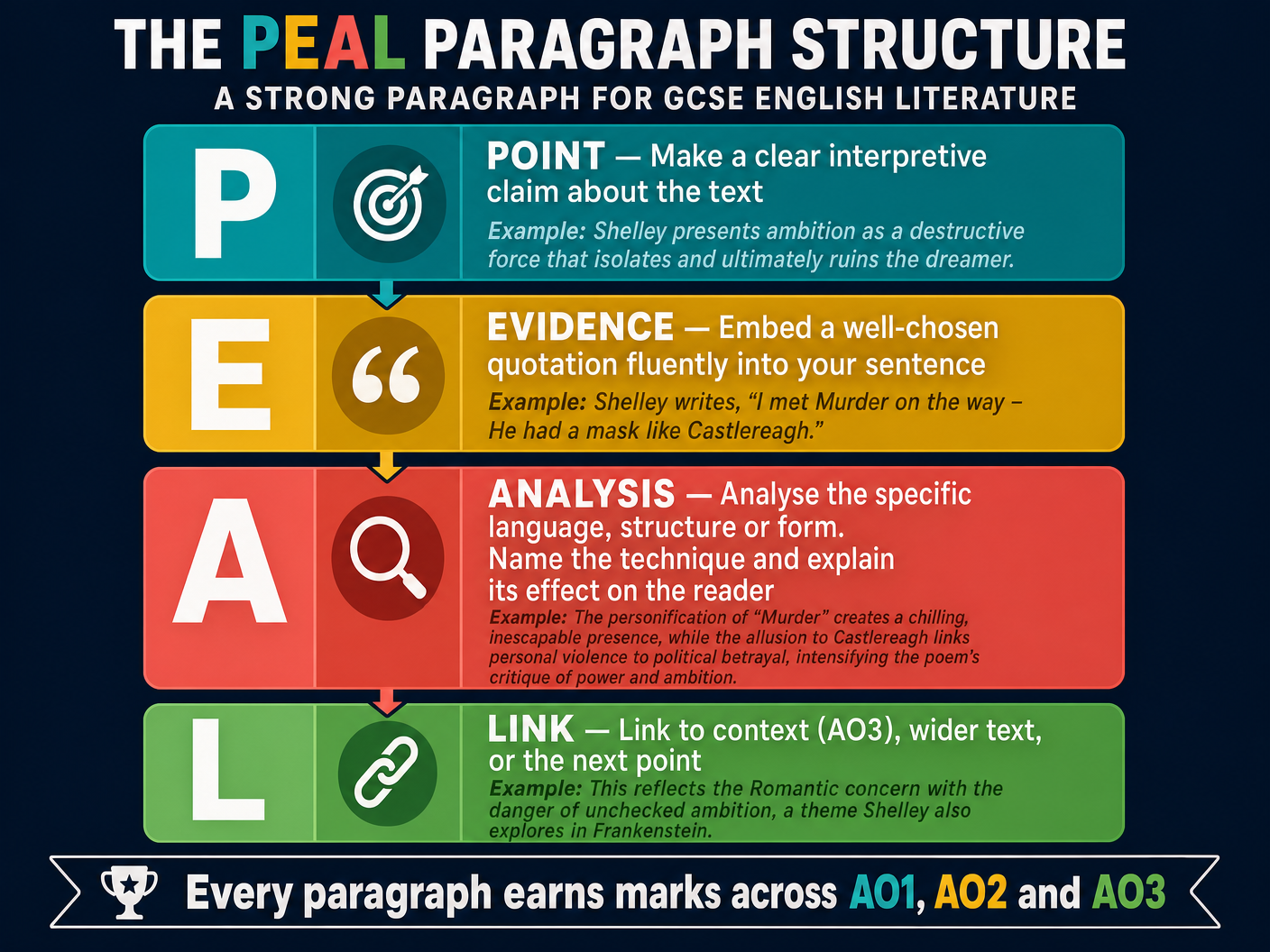
The Anatomy of a Perfect Paragraph
To consistently hit all the Assessment Objectives, structure your analysis paragraphs effectively. The PEAL structure ensures you make a point, prove it, analyse it, and connect it to the wider context or text.
Listen to our deep-dive podcast episode on Critical Reading for more detailed strategies and examiner insights:

Worked Examples
2 worked examples — open one to explore the question and available guidance.
Practice Questions
Test your understanding — click to reveal model answers
Read the provided extract. How does the writer use language to create a sense of tension and unease? (12 marks)
Hint: Focus purely on AO2. Look for short sentences, sensory imagery, and semantic fields of fear or danger.
Explore how the writer presents the theme of ambition in the text as a whole. (30 marks + 4 AO4)
Hint: Track the theme chronologically. How does ambition start? How does it change the character? What is the ultimate consequence?
Starting with this extract, explore how the writer presents the changing relationship between [Character A] and [Character B]. (30 marks + 4 AO4)
Hint: Remember the 50/50 rule. Start with the extract, but you must link out to how their relationship evolves across the wider text.
Compare how poets present the reality of conflict in 'Poem A' and one other poem from the anthology. (30 marks)
Hint: Do not write an essay about Poem A, followed by an essay about Poem B. You must weave the comparison throughout every paragraph.